Why don’t biologists write books? They can be a hard cell.

Obviously they do (a quick internet search will provide an extensive list of fiction authors from scientific backgrounds, from Crichton to Asimov, Kingsolver and McAuley), but Dad-jokes aside, it can sometimes feel that science and art are at opposite ends of some arbitrary scale. At school, I was encouraged to choose between the two. I surely couldn’t pursue biology seriously (which I loved) as well as writing (… which I loved). As if my brain would explode with confusion or something … and I was understandably fond of my brain, so I stepped away from stories and into the lab. Not the worst advice I’ve ever been given (that was to get a perm, aged twelve), but pretty terrible.
Because the sciences are powerfully creative, as are those who practice them. Science needs expansive, imaginative thinking. It needs vision, passion and inspiration. Science and art work well together.
If you’ve ever taken a creative writing course, you may have heard the idea-generating advice to: “Ask questions”—which is exactly what scientists do—with “What if …?” being the holy grail of both creative writing prompts and hypotheses. For example,
What if I add X and Y? (Kaboom! Maybe)
What if I take A away from B? (Ahhh. Oops. That’s not good)
It’s the scientific process: trying things out, observing results and continuing into discovery (or binning and pretending it never happened). Writers know this practice well; you give your protagonist one job to do, and off they go and do something entirely unexpected.
Not that it takes an artist or a scientist to appreciate the beauty and strangeness of the natural (or sometimes in my books, unnatural) world. My research was as much about science-based fiction and non-fiction*, but also (obviously) Attenborough … and yes, Octonauts too. Anyone with a passion for wildlife, ocean science, or climate change might find themselves swept along the tideline, wondering what if, why, or how?
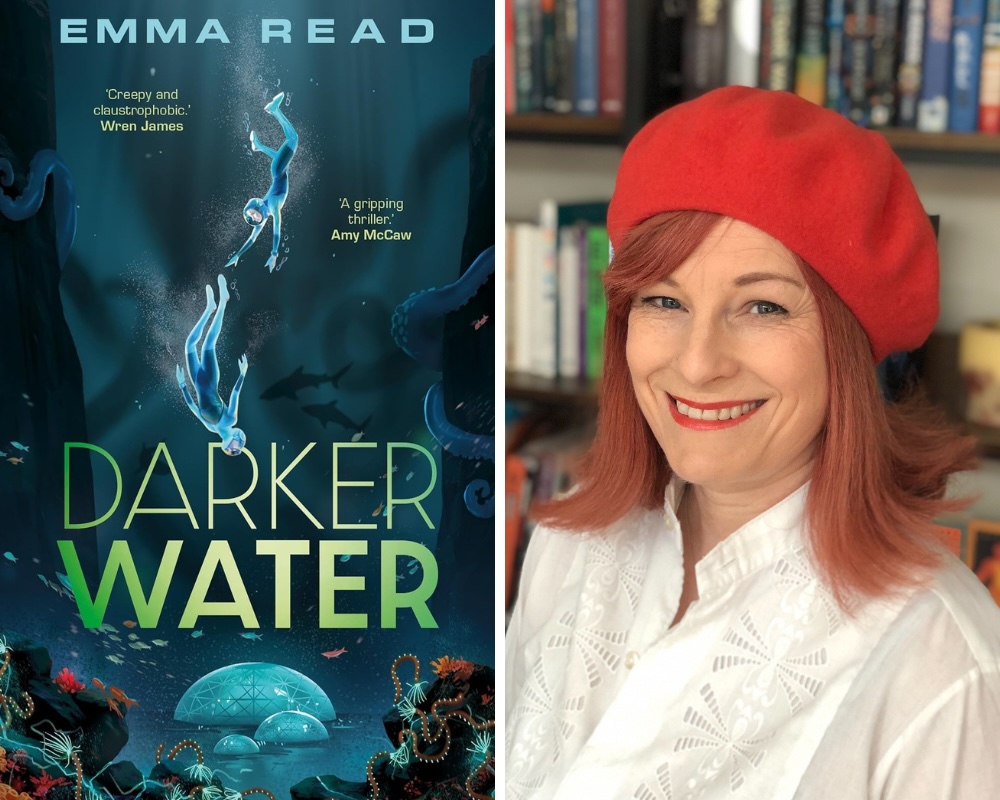
In pursuit of answers, I’ve crawled through my house to see the world from a spider’s POV for Milton the Mighty; invented rules for a (mostly) harmless, fungus-plant zombie for Silent Night; and most recently, dived 4km down into the darkness of the abyssal ocean plains. Darker Water is my most science-forward novel yet and it’s plunged me into some fascinating research on, amongst other things, the marine worm named Hodor hodor, being crushed by the equivalent weight of 35 elephants in all directions, and the marine snow that covers the abyssal sea bed, largely made of dead things and their waste-product-glue (it’s basically a carpet picnic for the local fauna, but where you eat the carpet.)
No hard sell here; biology and fiction are a perfect pairing, and I can’t wait to discover where my next expedition into the unknown takes me.
*The Brilliant Abyss, Helen Scales, The Bathysphere Book, Brad Fox, The Deep, Alex Rogers, Deeplight, Frances Harding and The Sunken Archive Duology, Sylvie Cathrall
Darker Water by Emma Read is out in paperback now.