Book Review: A Planet Called Happy by Riley August

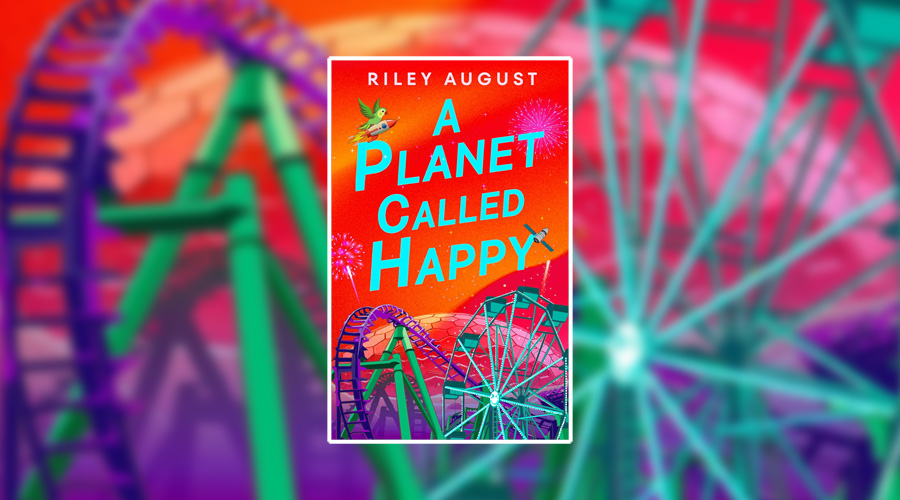
Nara works on Happy. It’s a theme park planet, designed to give high-paying guests anything they could want – her job is to watch their every move, arrange their stay to be as delightful as possible, whilst still extricating more money at every opportunity. She hates it, especially as her latest charge, Ellis, has been proving impossible to please. But as a difficult past and corporate malevolence have left her basically an indentured servant to the company that runs Happy, she has little choice in the matter.
Until, that is, a revolutionary group called Home Persists storms onto the planet, threatens its nefarious dealings, and offers Nara a way out.
Other than an opening fifty or so pages, which offer some necessary table-setting, Riley August’s A Planet Called Happy is almost entirely one big chase scene. The reasons and the personages change a little throughout the book, but for the most part, Nara and an initially grudging Ellis spend the whole duration rushing through the various different parks that make up the planet, trying to escape from its evil overlords.
That the pace is so consistently frenetic does get a little waring. There are a few points where it might have served the narrative for it to slow down, and let us spend more time getting to know the other characters who Nara is both running with and from. Though we spend significant time with Ellis and Trevyr, a sweet colleague of Nara’s who risks his personal safety to help her, the Home Persists gang are significantly less defined, which means less of an emotional impact when their own safety is in peril.
Still, there are worse problems for a novel for have than for it to be too pacy, and the speed with which August pulls us through all the different theme parks on Happy does prove an excellent showcase for their expansive imagination. They write with a wildly inventive, cinematic eye as we race through parks based on music festivals and pastoral scenes, thrill rides and virtual reality. As one chapter barrels into another, it’s always exciting to discover the next place they’re whisking us away to visit.
Perhaps the best thing about A Planet Called Happy however, is the way the novel set on another planet in the distant future taps into the emotional reality of our lives today. So much of the story revolves around the ambient despair of people trapped in a situation that only works for those at the very top of the tree, who can’t see any hope of things changing for the better. The Nara-like cogs in the grand machine of Happy, designed to make life better for the wealthy as they survive on the bare minimum themselves, are equated with the poor who fuel our fast-fashion, hyper-consumptive economy. AI also appears, as the book’s malevolently grinning big bad.
While August isn’t subtle about drawing comparisons between the planet called Happy and the planet called Earth, it doesn’t take anything away from their novel’s rousing, creative call to action. All in all, it’s quite the ride.
★★★★
A Planet Called Happy is published by Del Rey on 23 July 2026