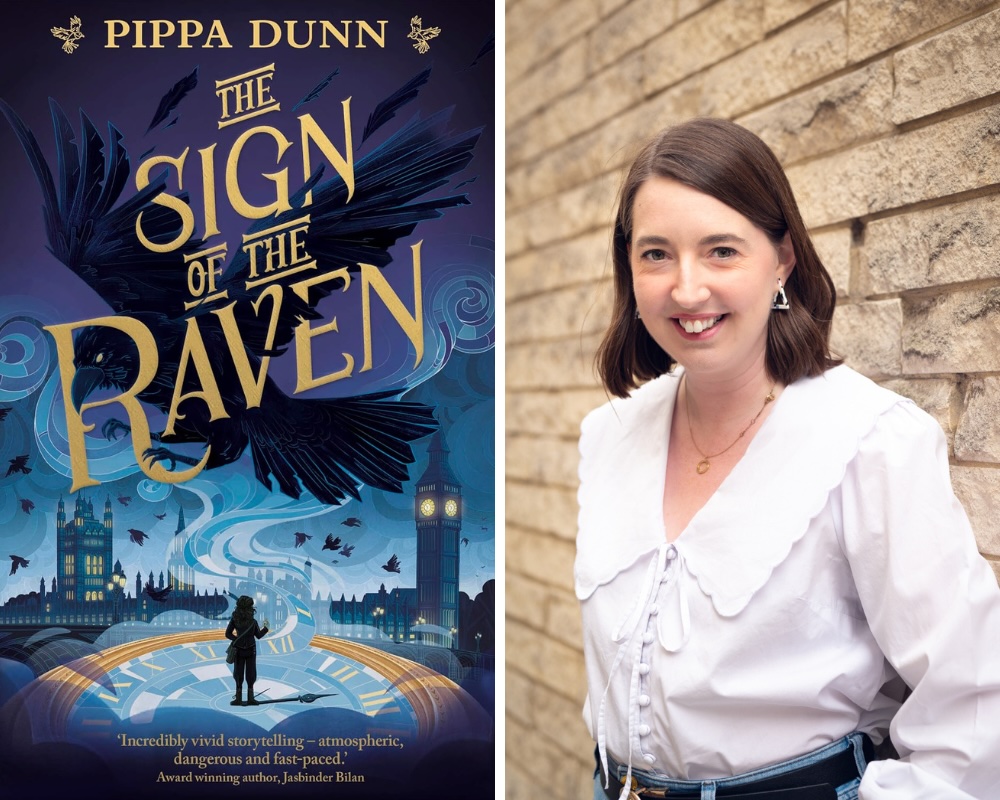
Pippa Dunn on drawing inspiration from the historical elements of London for The Sign of the Raven

London has always fascinated writers. Everyone from Samuel Johnson to Charles Dickens; Oscar Wilde to Virgina Woolf; Zadie Smith to Oisin McKenna have been compelled by its ever-changing tides, and as soon as I arrived – as a fresh-faced graduate drawn to the big smoke like so many before me – I understood why.
Soon I was a Londoner, working for a charity right in the heart of the oldest part of the city – the part known to locals as ‘The Square Mile’. It’s now London’s financial district, and at first glance it might seem like a modern metropolis of glass and steel, but look closer, and you’ll find a far older skyline hidden beneath the skyscrapers. Huddled between the wine bars and the office blocks are the spires of ancient churches still reaching for the sky. There are winding alleys, still black with the soot of centuries past. There are Roman ruins hidden beneath Georgian bank vaults. There are lost rivers and secret gardens and codes written into the stone of long-forgotten statues – and here and there, there are curious golden signs.
I found them affixed to the sides of buildings or sometimes swinging from metal brackets. A wheatsheaf, or a lamb, or a shoe or a key. Intrigued about what secrets they might reveal about the city I had become so enchanted by, I discovered that they were remnants of a pre-literate London. They denoted the trade that once had been practised within, or sometimes just served as an address – ‘The Sign of the Wheatsheaf’ – in an age when most people could not read.
Something about those everyday reminders of life so long ago captured my imagination, and suddenly all those thousands of years that I could feel beating beneath my feet wound their way into a story: a story set in a tavern that would once have been known only by the golden bird on its corner post: the Sign of the Raven.
It would be about a secret society of lucid dreamers, headquarted in that tavern and able to navigate a dreamworld in which time itself dissolved… and so where else could it be set but the old Square Mile? It seemed a fitting backdrop for a novel about time and tide, memory and imagination, the past and the future.
Sure enough, a few years of hard work later, I had not just a novel, but a love-letter to a city.
The Sign of the Raven might be a historical fantasy in which dreams are invaded by sinister government propaganda, but almost everything within its pages is rooted in something real. Its plot is shot through with actual events and characters from London’s past, and every single location is a place that young readers can visit. Most of them are still exactly as they were in 1889, when sixteen-year-old Ashlyn Threadneedle joined a secret society of lucid dreamers headquartered in a tavern with a golden bird on the corner post.
As Ashlyn herself thinks, the past and the future sit cheek-by-jowl, separated only by the turn of the page or the shuffle of a deck. There is a kind of magic at work in places like London, where generations of stories nestle one atop the other in the secret corners of the city. If you’ve never visited, then I hope that reading The Sign of the Raven will make you a true Londoner by its final pages, and if you have, then I hope that the next time you visit you’ll see it with Ashlyn’s eyes, and feel her story weaving its way through your own.
The Sign of the Raven was published by DK flip on 6 August 2026