Bex Goos on writing a book-within-a-book story

Every book I write is a house.
When construction is done, when the furniture has been arranged and the dust has been swept away, I open the door and invite you in. You walk through the house, take a look at the design and décor decisions I’ve made, and—hopefully—you decide to stay for a while, to live in the space, to explore each room. It’s a delight when you do. Truly it is. As a constructor of metaphorical houses, I am well aware that not every guest is going to agree with my aesthetic. Some might raise an eyebrow at the fuchsia drapes, for example, or the outdated wainscoting (I’m just kidding; my wainscoting is always in keeping with current trends).
It’s a big ask, isn’t it? Me requesting that you stay in this house I’ve built.
It gets more complicated when you walk into the house and see another, smaller, house smack dab in the center of the living room. I imagine you’d have some questions. To which I would reply: “Oh, that. Yeah, that’s… that’s a loadbearing house.”
When I write a book-within-a-book story, I’m not just asking readers to buy in to my story; I’m asking them to buy in… twice. Stay in the house, and stay in the smaller house that is inside the bigger house. Or, let’s be honest, stay in the larger house and occasionally peek in the windows of the smaller house. Maybe step inside—Watch your head!—and look around, but then retreat to the comfort of the “main” house again.
Why would I do this?
What do I gain by creating a secondary fictional world? How is the reader’s experience enhanced by the inclusion of a story within the story? It has to be worth it, right?
As I implied with my groundbreaking metaphorical language above, anytime another layer of fiction is added to the overall story, it has to serve a function. It has to support the primary story in some way. How? That depends on the author’s goals.
Sometimes, I think it is as simple as the fact that we are as fascinated by the storyteller as we are by the story. How do stories become? What is it about fiction that draws people in? The secondary fiction, in this case, gives audiences a chance to explore creativity on both a literal and figurative level, to interact with art and artist alike.
Other times, a secondary fiction is a representation of the themes and/or motifs in the primary fiction. Our brains like metaphors and symbols. The Babadook is more than a well-dressed ghost, for instance. He is grief. He is grief in a top hat.
When it came to writing Falling for the Protagonist, I used my secondary fiction for satirical purposes.
To me, satire is a flashlight. You shine it on something in order to illuminate its flaws. The light draws other people’s focus and shows them exactly where to look. This can be done in a lighthearted way, or because you’re seriously hoping to inspire major systemic changes for the betterment of society. Falling for the Protagonist is definitely in the former category.

I love romance novels. Even in the best of times, the real world is chaotic and often unjust. And we are definitely living somewhere very far away from the best of times. Romance World—or as the internet knows it, Romancelandia—is a just world. Good guys get married. Bad guys get punished. (Hey, I just summed up all of Shakespeare’s comedies!) It’s a balm for the psyche to exist vicariously through characters in romance novels. The certainty of happily ever after allows me to invest my emotions safely in the events leading up to the ending. I wrap myself up in the story like it’s a security blanket, and everything feels calm, and right, and comfortable.
Doesn’t mean I haven’t noticed some… patterns. And what better way to shine a light on romance novel tropes than to have a person from the “real world” (In quotes because the person in question is still very much fictional—Shh! Don’t tell her!) hop into the world of a romance novel and explore a bit? I wanted to juxtapose my secondary fiction against the more “realistic” primary fiction. Earlier, I said satire is a flashlight. I want to add now that satire is also a mirror.
“Look in here,” says Fiction to Reality. “Do you see yourself?”
Thus, the little house inside my bigger house serves its purpose, and I wave the reader off at the end of their visit, hoping they enjoyed their stay.
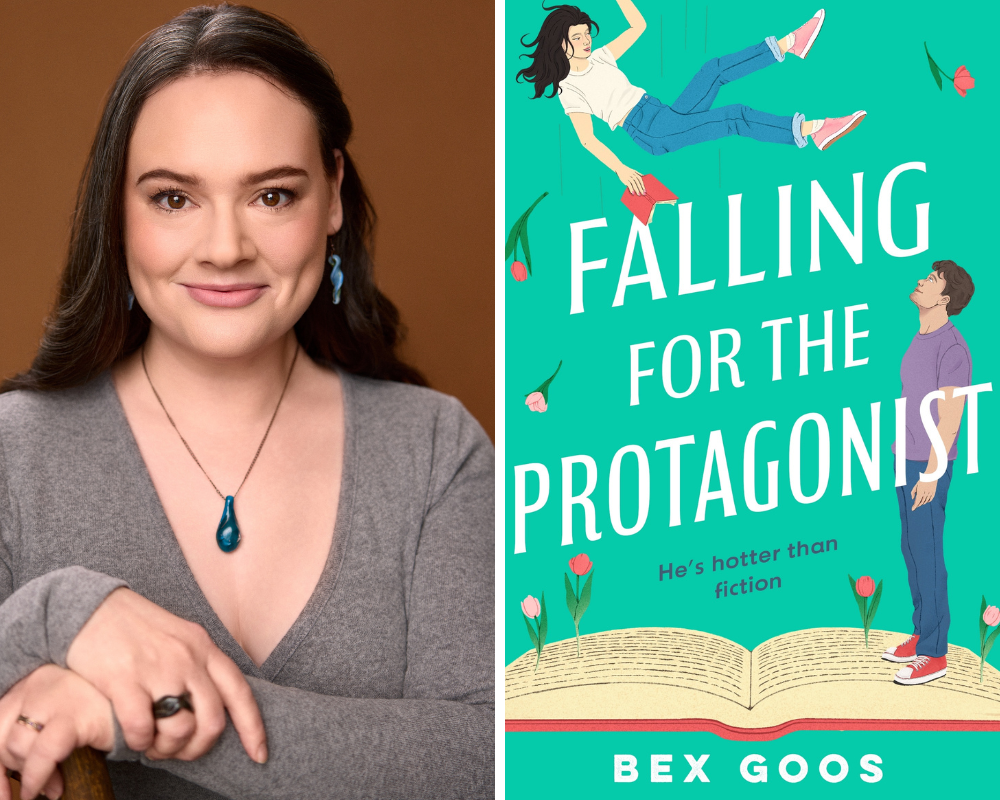
Falling for the Protagonist is the new rom-com by Bex Goos. Published by Head of Zeus on the 7 May 2026.