Dwight Thompson: Books and tracks that inspired My Own Dear People

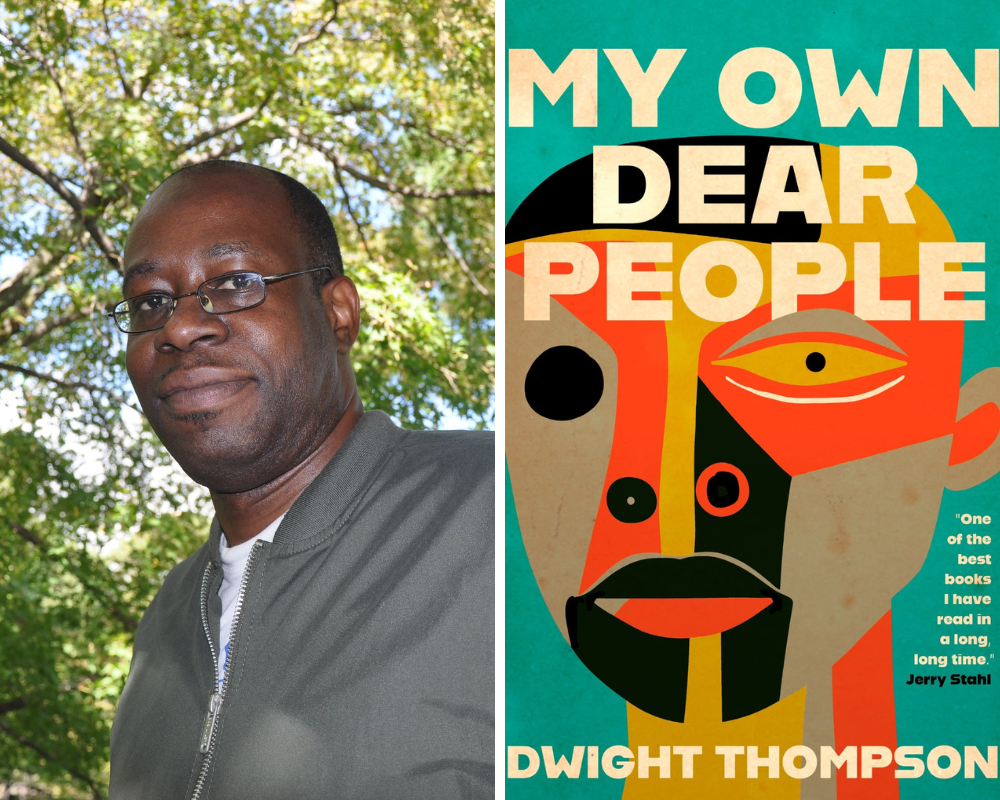
The title of my novel, My Own Dear People, is taken from V.S. Naipaul’s epistolary book, Letters Between a Father and Son. In one entry, Naipaul, writing from Oxford, addresses the letter to all his family members in Trinidad, by using the salutation, ‘My Own Dear People’, instead of to one family member as he usually did. He does so in a softly ironic way, complaining of the cold December English weather and loneliness and endless exams. He brags a bit about a story he read on the BBC, but the tone of the letter crystallizes into that of a young man refining his gift through unfiltered writing—becoming the West Indian we all loved in that first quartet of novels satirizing Trinidadians. His own dear people.
I felt like I was addressing this book to Montego Bay. I tried to turn this idea of the salutation inside out as not only ironic address but as a love letter from a son in exile, who is working towards some re-centering of myself through writing. Nyjah Messado, my protagonist, as the experiencing center of My Own Dear People, is going through a similar experience as he tries to find his moral footing and courage to do the right thing.
I thought a lot too about George Lamming’s protagonist, G, in In The Castle of My Skin. Lamming uses the intelligence and observation of G, as the window through which the reader views the legacy of colonialism and slavery in the rural Caribbean society of Barbados. Nyjah is moulded after G; it is through Nyjah’s narration that the reader gets access to the effects that gender and gangster politics and educational elitism have on the society, much in the same way that it is through G’s narration that the reader gets access to how the effects of the politics of race and capital are disturbed as education and labor movement lead to sudden, violent riots in a rural, passive and feudalistic society. One novel can be seen as the mirror of the other.
Lamming once remarked that, “I do not know whether literary scholars make the connection, but one of the functions of the novel in the Caribbean is to serve as a form of social history.” I also took this to heart when writing, particularly the way Flannery O’Connor’s early stories, especially the collection, A Good Man Is Hard To Find and Other Stories, serve as a form of social history of the South and how her story, The Displaced Person, stopped me dead in my tracks with its head-on confrontation of a Polish immigrant farm worker, unspoiled by American racism, dying a Christlike death for his naivety. I saw the beginnings of my treatment of homophobia in my novel in this story. It was a turning point, this whole notion of the persecution of innocence.
The songs basically picked themselves, or more to the point, each song conjured a crucial memory. When I was growing up, whenever well-known prostitutes used the city telephone boxes to call pimps and customers (there were no cellphones), people who followed them always made a show of wiping the receiver then further holding it away from their lips. I remember one day as this happened, I heard: “Montego Bay people too damn ignorant an’ chupid!” exploded an old woman watching the farce. “Yuh know white people used to do de same damn ting when I use phone box in England. Now look at all yuh!” The woman shamed the whole street or at the very least, turned their scorn into introspection. And the song, Hood Top, by Shabba Ranks was playing on a sky-juice cart nearby. So whenever I write, that song’s raucous critique of the sexual hypocrisy of overweight women always translates in my head as a critique of social hypocrisy.
Rod Stewart’s tender, That’s What Friends Are For, echoes the importance of friendship and camaraderie amongst boys in the novel, as loyalties are tested and accountability called into question when Nyjah finally finds the courage to confront his past mistakes.
Jerry Butler’s, Let It Be Me, serenades an early scene in chapter one where a little tourist boy rescues his mother from choking on a citrus seed. This life-saving gesture triggers a memory in Nyjah of ‘Lady Lazarus’, his code name for Maude Dallmeyer, the rape victim from his school days. The breezy nature of the song is a counterpoint to the near-tragedy on the beach and the trauma Nyjah recalls.
I picked the name Maude from an incident I witnessed while I was in high school—an incident that taught me an early lesson of the vulnerability of girls in a society that sets them up for failure and abuse, even from parents.
I was at the supermarket’s food court and this girl Maude’s mother, who had a heart-shaped, youngish face but white hair with a touch of fading purple dye where it banged in her face, took an aggressive bite of her festival. The daughter put her hands in her lap and twisted her fingers and tapped her foot. “Talk, Maude…,” said the mother crunching her fried fish. Maude, who went to the catholic school across the street from my school said, “Mummy…it never occurred to me…when he was rubbing my feet—” “Never occurred to yuh that what,” the mother cut off the teenager, banging her fork down, “that him have a cock? And dem usually like to use it? Lissen gyal, shut yuh blasted mout’.” She started pelting Maude’s face with licks. “Out! Out! Ah gwine kill yuh when we reach home! Fuckin’ bubuh…wha’ yah learn at Mt. Alvernia?” She bashed Maude’s face with the handbag and a man grabbed her: “Mummy tek time wid her …” The girl bawled her eyes out and hurried out. The woman flounced and stepped to the cashier, paying and watching her daughter waiting on the sidewalk. “She gwine breed…she gwine breed before her time,” she told the cashier offhandedly. The cashier, a young woman, took a look at Maude and agreed. “Why me never have two bwoy pitney?” mourned the woman. “All children a blessing mummy,” said the man who’d intervened. “Dem jus’ need guidance.” The woman paid as much attention to his advice as if it had come from a dummy.
My Own Dear People is published by Cassava Republic Press on 21 May 2026