Read an extract from To Dream in Darkness by Ann Liang

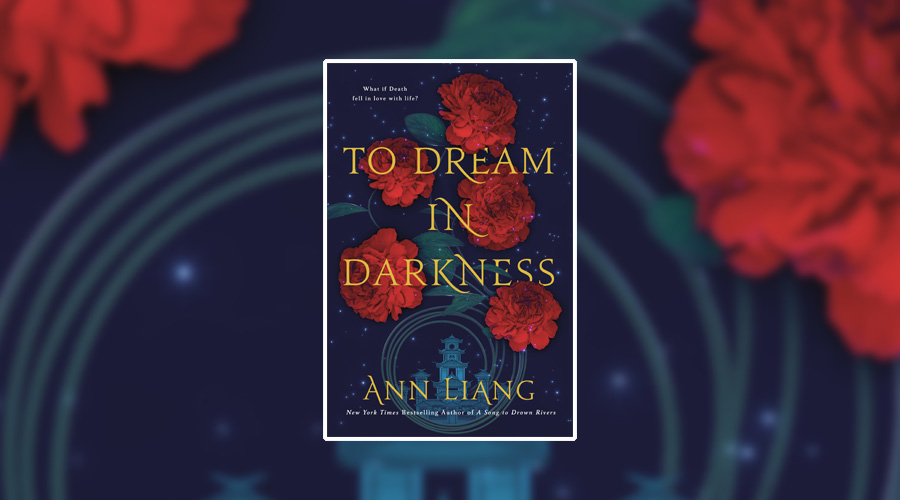
China is in the Age of Brilliance, where gods freely wander the three realms. Amongst them is the cruel and beautiful Death God, who has never failed to collect a soul on time. Until now. For when he seeks out Rujia, the noble god of healing, she makes him an offer he can’t refuse: she will help lift the excruciating curse placed upon him if he gives her a one-month reprieve.
Rujia’s deal with Death is merely an excuse to buy herself time. But when her plan causes the Celestial Palace’s collapse and the beloved crown prince’s disappearance, she and Death are both held responsible. The only way to avoid the wrath of all the other gods is to travel across the realms and safely retrieve the crown prince themselves.
As the unlikely alliance between them blooms into more, and Death’s resolve to kill Rujia weakens by the day, neither can outrun their intertwined fate without devastating consequences…
READ AN EXTRACT FROM TO DREAM IN DARKNESS
Contrary to what those pesky mortals might believe, the Death God does not enjoy killing.
He does not even kill, really. Such violence is beneath him. He is the breeze that floats in through an opened lattice window, the gray smoke rising from a burned incense stick, the blood seeping from a fresh-made wound. He only appears when the last breath has already been drawn and the skin has already gone cold.
At least, that is how it has always been.
The truth is much less dramatic than the silly tales they tell at teahouses in the Mortal Realm about him arriving with a sword in his hand and murder on his mind. He had stayed once to listen out of morbid, misplaced curiosity, and while he hadn’t expected much in the first place, he still found himself scoffing at what he heard:
“He has horns and fangs and claws that can cut the body into clean halves.” He is not an animal.
“He will slaughter the husband first and seduce the wife second.” Mortal flesh holds as much temptation to him as the carcass of a lamb.
“He spends every waking minute planning out the most painful death possible for his next victim.” Perhaps, given their nature to make everything about themselves, the mortals would be disappointed to find that he barely thinks of them at all. That as he drifts through the crooked streets and alleys, passes from house to lantern-lit house, collecting the souls with weary expertise, he is most concerned about returning to the Night Realm as early as possible.
So it’s something of a relief to be stepping back through the enchanted doors, into the dim, empty halls of his palace. He brushes the dust from his sleeves, though the scent of mortal fruit and fire clings to him. He forces himself to tolerate it; he is almost done now. His robes trail behind him, whispering against the smooth, polished stone, and the souls float a little farther behind, glowing softly, just as white as the eternal snow falling outside. Just as silent.
More sets of heavy doors heave open on their own when he approaches until at last, he finds himself standing before the gates to the Yellow Springs. The final destination for the souls and his final destination for the night.
He lifts a hand. For a moment, nothing happens—as expected. These gates are ancient, after all, hundreds of centuries older than he is, used by the Death God appointed before him and the Death God before that. He would not be surprised if they had been created at the very beginning of the Three Realms, the images of the dragons and lilies carved deep into the wood by the first immortal. Then the gates rumble. The dragons uncoil and slither to the sides as if alive, and he is greeted by a darkness so complete that the surrounding obsidian walls seem bright by comparison. That even he, dressed from head to toe in pure black, stands out against it. It is a darkness that stretches on and on, without shape, without edges. As a child, he had been terrified that he would enter and be swallowed whole by it. Simply step in and disappear.
But he has not been a child in eons.
He keeps walking, chin up, shoulders straight, the souls gathering closer around him, illuminating the way. There is a faint humming sound building in the background, like a thousand voices conversing quietly in a faraway room, and soon it merges with the rushing of water. He can taste the water on his tongue, the unpleasant blend of salt and ash and copper. He can feel it, too, the shock of plunging into those frozen depths, of sinking farther and farther as the darkness pours in over his head, the voices sharpening into screams, sobs, pleas…
The ever-present throbbing in his skull intensifies. He squeezes his eyes shut. Presses two fingers to his temple, as if he can physically drive out the pain.
Useless.
He does not know if he means himself, or the curse, or the hundreds of so-called cures that have promised everything and solved nothing.
But never mind that. He has a job to complete first; he will be free to suffer afterward.
The souls begin to quiver, their pale light glossing the Yellow Spring’s surface. Some seem to know the path forward and are eager to let themselves be swept away by the currents, into the next cycle of the afterlife. Others grow restless, flitting left and right like fireflies. These ones he guides downstream with his own hands.
When the very last soul has left the shore, he rises and turns to go, but a ripple in the air catches his eye.
The Death God frowns.
This is unusual, but not entirely unseen before. Most deaths are natural, inconsequential, no more worthy of attention than the dropping of flies. But some deaths are written out in the constellations in such a way that if they do not come to pass, the balance of the universe is disrupted. Like rocks to pebbles, these souls tend to weigh heavier, to cast stronger waves when they fall. So as the ripple expands outward, forming a mirage, he anticipates the death of an ancient god, perhaps one of the higher-ranked officials from the Celestial Realm.
Yet instead of shining gold pillars, red-crowned cranes, and dusk-painted clouds swirling around the steps to the Celestial Emperor’s throne, he is shown a vision of the sea.
The sea, a lone cottage on a floating island, and a god.
She is gathering herbs from the back garden, her long hair spilling over her shoulder as she plucks a peony and holds it up to the brilliant daylight, her robes the same blue and white as the foaming waves below her. He has never met a god from the Celestial Realm who could be described as kind before, yet there is something undeniably kind about her features. The harmony of her long lashes with her soft lips. The care with which she touches the petals.
Then the vision changes. The sea vanishes. The cottage disintegrates. Only the god remains, but she is crumpled on the floor, a crimson puddle spreading rapidly around her. A sword twisted deep into her chest while she lies there, mouth opening and closing, her face contorted in pain.
And he sees himself in the mirage, his hand around the weapon, his fingers stained red.
His frown deepens. His next breath comes out too fast, too sharp.
He is almost tempted to think it a mistake, except the Heavens are never wrong, never to be defied. He can feel the will of the Heavens pressing into his mind like a blade into flesh. This is the fate designed for the kind-faced god who picks flowers and lives on the sea, and he is the one who must see it through. It is insulting to know that he will be acting exactly as the mortals imagine him, that he will no longer be able to correct them when they say his hands are tainted. How uninspired. How inconvenient. And how deeply ironic.
The Death God does not enjoy killing. He has never killed at all—
Until now, that is.
To Dream in Darkness is published by Tor on 29 October 2026