The Movie Scene Method: Sloane Fletcher on Plotting Novels at a High Level

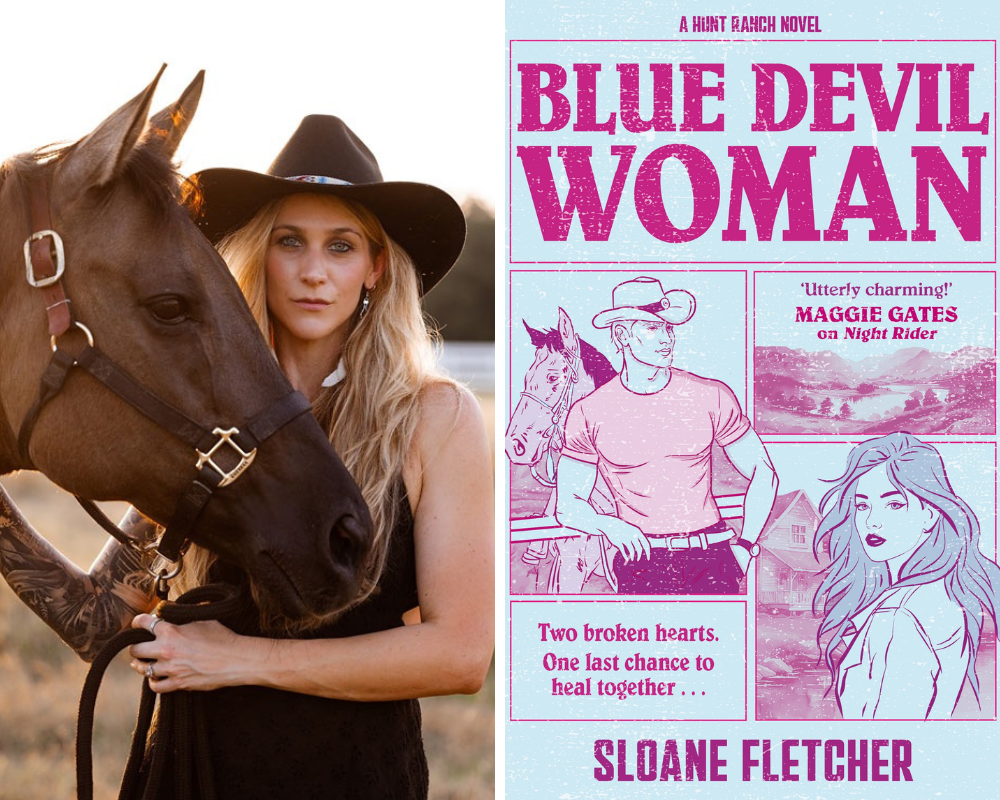
Someone recently asked me if I was a plotter or a pantser. I replied, “Pantser. Absolutely.” This answer felt true. As an author, I don’t spend much time plotting out my novels; instead, by the time I eventually sit down to put a story to paper, the characters have lived rent free in my head for so long that I know where they’re from, who they are and what their strengths and weaknesses are.
It was surprising then, when I sat down at my computer the next day, opened my notebook and focused on my chaotic, bulleted list of what I’ve always informally called my “movie scenes.” These bulleted points, in no semblance of order, are impactful one-liners beneath which is a jumbled collection of secondary character information, questions, and potential plot threads. For my upcoming novel, Blue Devil Woman, a second-chance romance that follows a couple who reconnect after having a stillborn baby, one of these movie scenes looked like this:
Flashback. Barn, Hunt Ranch. First time Benji (24) and Sierra (19) have sex.
- Sierra goes to find Benji and taunts him with the (fake) date she’s going on.
- Show that she can be manipulative to get what she wants—and that Benji doesn’t take her shit like everyone else does.
- Makeshift bed out of hay bales(?)
- Benji reminded of his poor background and that he has nothing to give Sierra.
- First “I love you” exchange as relatively untried kids.
- Could contrast with after Baby Girl dies, when they love each other but that love feels like a cage of shared trauma.
- Q: How do they break out of that cage?
What was more surprising than the realization that I was, in some sense, a plotter, was the realization that I had a methodology too (gasp!). But here is why you should try the Movie Scene Method:
- Divert from Chronology. Humans tend to associate planning with order and chronology. This is great if you’re working a corporate job and have an intense list of to-dos and various timelines to get them done by. Less great if you’re trying to engage a reader in an intense, emotional journey. Implementing the Movie Scene Method helps you to plot outside of a chronological timeline, thereby lending your manuscript’s timeline texture.
- Focus on Moments. Visualizing your book as a series of movie scenes allows you to capitalize on moments. Movies don’t shift slowly from day to day, hour to hour. They jump from action to action. Moments might not flow in a precise chronological timeline, but because you’ve visualized those moments for a reason, they typically already have a lot to do with your characters and your plot. Moments are what you want readers to talk about when they’re done reading your book, but they’re also a powerful high-level plot progression tool that allows you to capture a series of intense emotional snapshots and your characters’ reactions to them (i.e., character growth/regression).
- Use Diverse Locations. The Movie Scene Method allows you to see a high-level play-by-play of your different locations and what’s happening in them. For example, in Blue Devil Woman, Sierra’s bedroom is completely different prior to losing her baby than it is after. The moment Benji is allowed back into this once intimate, shared space, the change in her bedroom from when he last saw it shows him just how bad her dissociation and extreme need for control is, and he begins to make strides to help her confront her trauma instead of tiptoeing around her as he had done previously. Locations don’t just build your world; they are perfect opportunities to indirectly progress your plot and your character arcs.
- Pull the Threads. If you’re writing a book, you want your readers to feel your characters’ pain, but also their moments of joy. You want them to be emotionally invested. By the end of the book, your characters should all have endings that correlate to their growth—or lack thereof. Implementing the Movie Scene Method will highlight which of your characters’ emotional threads are recurring. These are the threads you pull to tie one scene to the next, to develop your character arcs, and to compose a coherent story while still capturing the chaos and incongruity of individual moments.
So, if you’re having trouble plotting, jot down your characters’ strongest moments, give those moments a location that says a lot about your character(s), and then begin to weave those moments together (i.e. progress your plot) by pulling on the recurring emotional threads. I think you’ll be surprised by how much of your story is already in your brain, and how, by breaking it down into movie scenes, you’ll be able to draft a much more compelling first draft.
Blue Devil Woman by Sloane Fletcher is published on 7 May by HQ Digital